
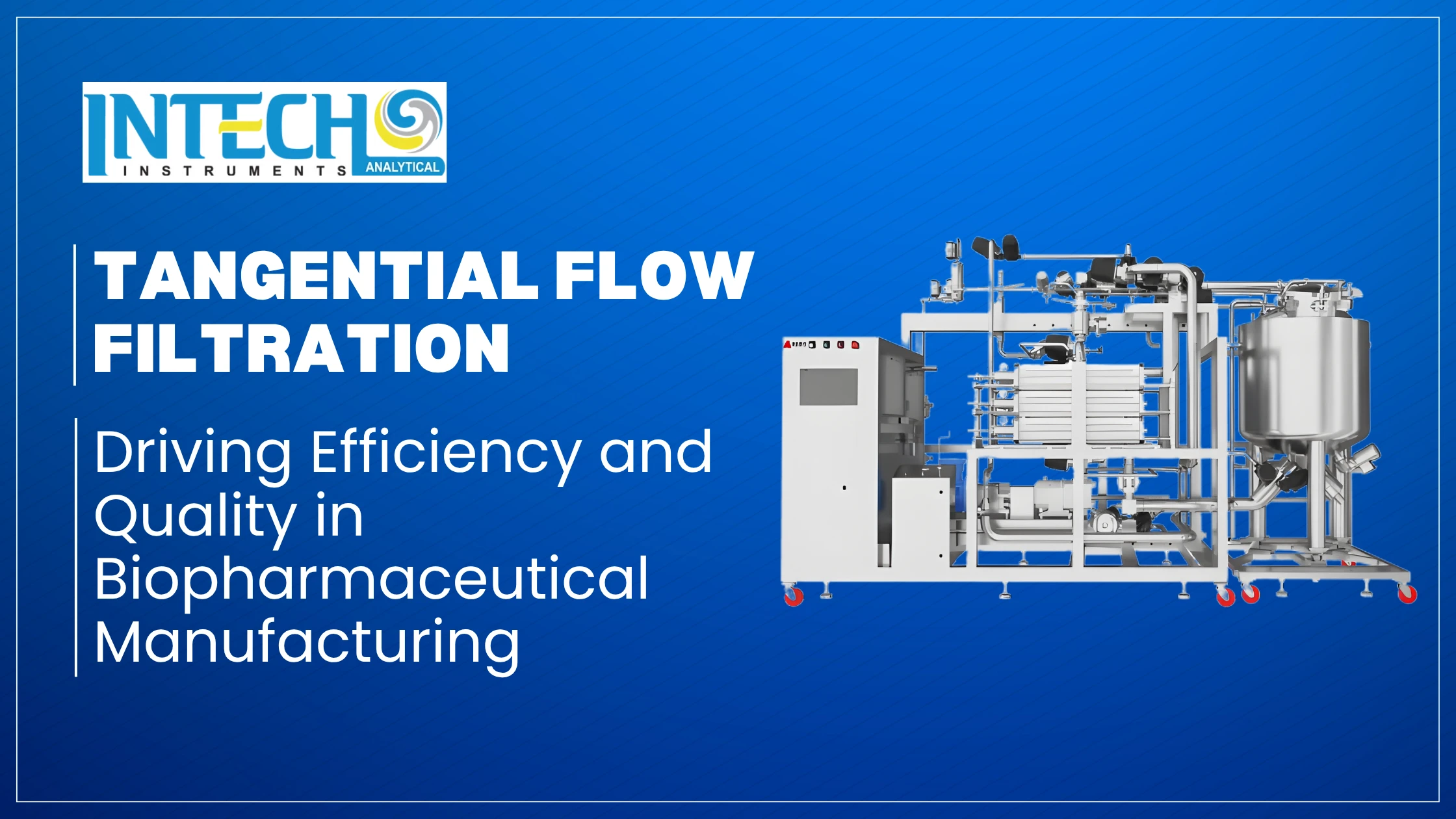
In the production of biopharmaceuticals, the increasing complexity of biologics, from viral vectors and nucleic acid-based treatments to monoclonal antibodies and recombinant proteins, has placed additional demands on separation technologies. In addition to providing scalability and dependability, the industry today demands solutions that guarantee product consistency under ever-tougher regulatory scrutiny. Tangential Flow Filtration (TFF) has become a crucial process in this context, allowing for the effective concentration and diafiltration of delicate macromolecules while maintaining molecular integrity.
TFF keeps a tangential feed flow over the membrane surface, in contrast to dead-end filtration, which forces fluid through the membrane perpendicularly. This architecture supports increased throughput while significantly reducing fouling, mitigating concentration polarization, and extending membrane life. These operational features are essential for both optimizing production and guaranteeing reproducibility at various sizes, ranging from large-scale bioprocessing facilities to exploratory laboratory settings.
TFF on a Laboratory Level
Lab-scale TFF Filtration System provides a degree of experimental control that is essential for process variable optimization throughout the development stage. By carefully adjusting parameters including transmembrane pressure, shear rate, and membrane pore size distribution, scientists can balance molecule stability with product recovery. These systems are especially useful for understanding how viral particles behave under shear stress or for describing the relationship between hydrodynamic circumstances and protein aggregation.
One cannot stress the significance of scalability enough. Because TFF adheres to the same basic principles regardless of system size, results from lab-scale tests are consistently translated to pilot and production stages. When therapeutic candidates move from research settings into current Good Manufacturing Practice (cGMP) facilities where process repeatability is crucial for regulatory compliance this feature lowers the chance of deviations. Laboratory TFF platforms essentially serve as the foundation for technology transfer, guaranteeing that early development-optimized conditions may be smoothly transferred to commercial production.
Design of Advanced Filtration Equipment
The intricacy of TFF’s Filtration Equipment is inextricably linked to its effectiveness. Chemically robust membranes ,designed to minimize non-specific adsorption and endure rigorous cleaning and sanitization procedures are integrated into modern systems. This is crucial for delicate biomolecules like adeno-associated viruses or recombinant proteins.
The integration of real-time monitoring via sophisticated sensors and automation modules is equally crucial. These characteristics guarantee product consistency and regulatory compliance by enabling operators to keep crucial process parameters within tight tolerances. Proactive rather than reactive modifications are made possible by in situ monitoring of flow rates, transmembrane pressures, and protein concentrations. The design of equipment so directly supports the concepts of risk reduction and quality control in the manufacturing of biopharmaceuticals.
Applications at the Industrial Scale
The TFF Filtering System exhibits unparalleled adaptability on an industrial scale. It is used in a variety of unit activities, such as final formulation, buffer exchange, virus clearance, and harvest clarifying. Every case demonstrates how TFF may be tailored to meet various process needs.
For instance, TFF ensures lot-to-lot uniformity and regulatory compliance in the manufacturing of monoclonal antibodies by removing leftover host-cell proteins and nucleic acids in addition to concentrating the output stream. TFF makes it possible to reach high-yield concentration without sacrificing biological activity, which is difficult for traditional centrifugation techniques to do in modern modalities like cell and gene treatments, where viral vectors or extracellular vesicles operate as the therapeutic agents themselves.
Because of its adaptability, TFF is essential in contemporary facilities that need to handle an increasing variety of biologics, such as fusion proteins, bispecific antibodies, and oligonucleotide-based treatments. As pipelines grow into next-generation modalities, the flexibility of existing systems enables quick adaptation to new molecules without requiring significant production line re-engineering.
Design Alignment with Quality
TFF’s interoperability with the quality by design (QbD) framework is one of its unique advantages. Manufacturers are able to exhibit process robustness and reproducibility, two fundamental principles that are closely examined by global regulatory bodies, because the operation is intrinsically observable and controllable. Product quality and process knowledge are aligned when TFF is integrated into QbD strategies, changing it from a simple unit operation to a source of data and control.
This connection has been further strengthened by recent developments in modular system engineering and membrane architecture. These developments strengthen TFF’s position as a predictive, scalable, and regulatory-friendly platform in addition to expanding its applicability to new treatment classes. By promoting continuous manufacturing processes that reduce waste while guaranteeing steady output, TFF Tangential Flow Filtration System actively supports industrial sustainability in this way.
The inherent compatibility of the Intech – Hanbon TFF platform with quality by design (QbD) principles is what makes it unique. The solution enables producers to easily achieve process resilience and reproducibility, two qualities that are rigorously examined by international regulatory agencies, by combining sophisticated sensors, modular setups, and precisely built membrane topologies. Intech-Hanbon TFF machines, in contrast to traditional filtration technologies, are made to be intrinsically measurable and controllable, guaranteeing smooth compliance and reducing process variability. This makes them a progressive option for both well-known biologics and the developing field of transformative medicines, such as bispecific antibodies and nucleic acid-based treatments.
The importance of Intech-Hanbon Tangential Flow Filtering System will only increase with the acceleration of the global demand for biologics. These systems stand out not only as filtration tools but also as facilitators of industrial dependability and therapeutic innovation by connecting the experimental accuracy of lab-scale operations with the dependability needed for full-scale biomanufacturing. Intech-Hanbon stands apart in a competitive industry thanks to their dedication to ongoing design innovation, which guarantees that their TFF solutions will always be uniquely suited to serve next-generation biopharmaceutical pipelines.