Choosing the right Preparative Hplc Column can determine whether purification feels controlled or frustrating. The decision begins with the sample, not the instrument. Compound polarity, molecular size, solubility, and target purity all influence column performance.
An experienced chromatographer will examine the stationary phase before comparing column dimensions. Reversed-phase C18 suits many compounds, but it is not a universal answer. Normal-phase, ion-exchange, or size-exclusion materials may perform better for specific separations. Sample loading also matters. A column that handles five milligrams efficiently may fail with a fifty-milligram injection.
Small details matter.
Particle size affects resolution, pressure, and processing speed. Larger particles often reduce backpressure, while smaller particles can sharpen difficult separations. Column length, internal diameter, flow rate, and solvent viscosity must work together. Always check the manufacturer’s pressure limits and chemical compatibility data before running a valuable sample.
Practical experience adds another layer. A method that works perfectly for an analytical column may overload during scale-up. Gradient delay, fraction volume, and detector response can change unexpectedly. That is easy to underestimate. Reliable selection therefore combines published specifications, laboratory trials, and documented performance data. Keep the first run conservative, with modest loading and carefully collected fractions.
There is no flawless shortcut. Even experienced users sometimes choose a column based on familiar chemistry instead of actual sample behavior. Reviewing chromatograms, recovery results, and impurity profiles encourages better decisions. This guide explains how to compare column chemistry, dimensions, loading capacity, pressure limits, and scale-up requirements with greater confidence. The goal is a practical choice that protects sample quality, equipment, and reproducibility.
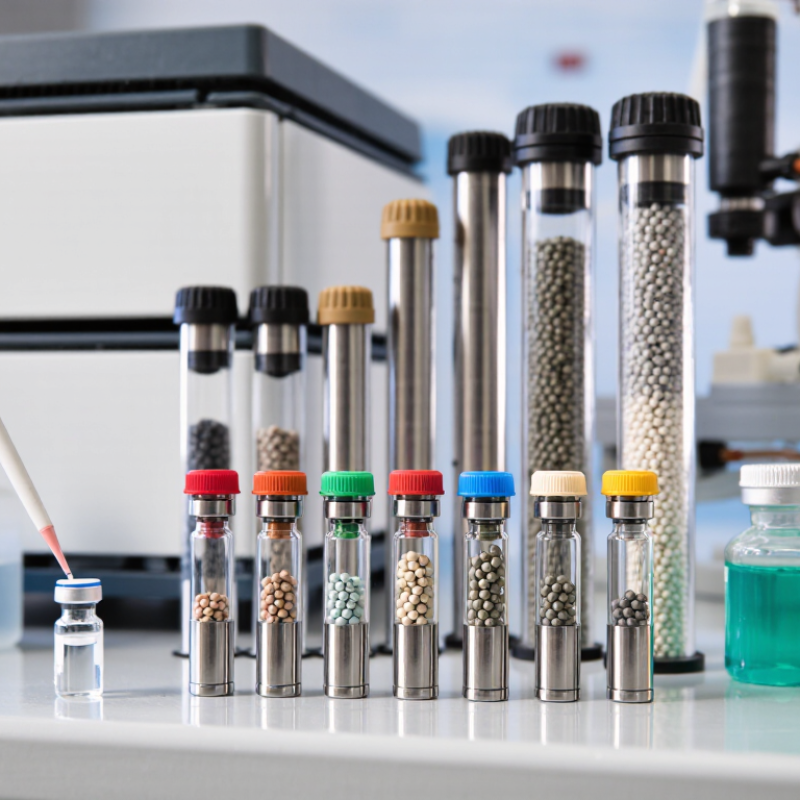
Choosing a preparative HPLC column starts with purpose, not catalog dimensions. Define the target compound, expected purity, and separation difficulty. If the goal is impurity removal, resolution may matter most. If the goal is recovery, capacity and yield become critical. A column that resolves two peaks analytically may overload badly during isolation. That mistake is common.
Scale means more than sample mass. Record injection volume, concentration, target recovery, and available solvent. For a few milligrams, a narrow column can reduce solvent use and sharpen bands. For gram-scale work, wider columns and stronger hardware may be necessary. Calculate loading from real trials, not nominal specifications. Start conservatively. A useful first run may use 10–20% of the stated capacity, then increase gradually. Monitor pressure, peak shape, and fraction purity. If peaks broaden, the column is telling you something.
Match the stationary phase to the sample’s chemistry. Reversed-phase columns suit many polar and moderately nonpolar compounds, while normal-phase methods may help with different solubility patterns. Check solvent compatibility, pH limits, pressure ratings, and fraction-collection needs before ordering. Do not choose by particle size alone. I have learned to distrust a perfect-looking pilot chromatogram; overloaded runs often reveal problems later. Keep detailed records of flow rate, gradient, temperature, and recovery. Those details make the next column decision more reliable.
When choosing a preparative HPLC column, match its dimensions to the sample load and planned flow rate. Column diameter mainly determines how much material the bed can accept. A small-diameter column suits milligram-scale purification. Larger diameters support higher loads, but they also consume more solvent. Measure your actual sample mass, not the amount in the original reaction mixture.
Column length affects separation power and solvent use. A longer bed may resolve closely eluting compounds more effectively. However, it also increases backpressure and run time. Internal diameter should scale with loading needs and flow rate. If the diameter increases, flow usually must rise to maintain a similar linear velocity. Simply increasing flow can reduce resolution and overload the pump. Watch the pressure trace carefully.
In method development, I begin with a modest load and inspect peak shape. Broad, uneven peaks often indicate overloading or poor sample solubility. A practical starting point is to keep the load below the column’s stated capacity, then increase it gradually. Capacity values are useful, but they are not guarantees. I have seen clean analytical peaks become distorted during scale-up. The mistake was treating sample mass as the only variable. Injection volume, solvent strength, particle size, and feed concentration also matter. Record these details after every run. Small differences can change the result.
Match column dimensions to sample load and flow rate by comparing column diameter, bed volume, and the approximate flow rate required to maintain the same linear velocity.
Choosing a preparative HPLC column begins with the stationary phase, not the column diameter. The target molecule’s polarity, charge, hydrogen bonding, and size should guide this decision. Reversed-phase silica often suits moderately polar compounds, while ion-exchange phases help separate charged molecules. Large biomolecules may require size-exclusion materials.
Selectivity matters more than theoretical efficiency during early method development. USP General Chapter <621> identifies resolution and system suitability as essential chromatographic controls. ICH Q2(R2), adopted in 2023, also emphasizes demonstrating specificity with suitable separation procedures. A 2024 global HPLC market analysis reported steady demand for high-throughput purification, with preparative applications expanding alongside pharmaceutical and biotechnology research. That growth does not make column selection easier. Complex samples still expose weak decisions quickly. I usually compare two or three chemically different phases, even when one seems obvious. No stationary phase wins every matrix.
Tips: Screen pH compatibility first. Then check sample solubility. Use a short scouting column before committing to a larger bed. Record loading, recovery, pressure, and peak shape. A sharp analytical peak may overload badly during preparation. I have seen clean small-scale separations become broad, tailing bands after scale-up. That result is frustrating, but useful. It often reveals excessive loading, poor solvent matching, or an unsuitable phase. Industry method-development guidance consistently supports controlled screening, documented system suitability, and recovery testing before routine purification.
Choosing a preparative HPLC column requires more than matching dimensions to your instrument. Particle size, pore size, and column hardware directly affect resolution, pressure, loading capacity, and fraction quality.
In practical method development, I often begin with particle size. Smaller particles can improve resolution, but they create higher backpressure and may shorten cleaning intervals. Preparative columns commonly use larger particles than analytical columns to balance flow rate and pressure. A 10–20 µm particle may suit routine isolation, while smaller particles can help when closely related impurities remain. Check the instrument’s pressure limit before increasing flow.
Pore size must match the sample’s molecular dimensions. Small molecules often perform well with pores around 80–120 Å. Peptides and larger biomolecules may need 200–300 Å pores to enter the stationary phase efficiently. Poor pore selection can cause weak retention or broad peaks. It is easy to overlook this.
Column hardware matters just as much. Select a pressure-rated body, chemically compatible seals, and frits that prevent particle escape without restricting flow. Inspect the inlet tubing and fittings; excessive dead volume can blur narrow preparative peaks. I have seen good chromatographic methods lose purity because the collection tubing was too long. That was a hardware problem, not a separation problem. Review loading studies, pressure traces, and recovery data together before finalizing the column.
| Selection Dimension | Typical Options | Best-Fit Application | Main Advantages | Potential Limitations | Practical Selection Guideline |
|---|---|---|---|---|---|
| Particle Size | 3–5 µm | High-resolution preparative separations and small-scale purification | Higher efficiency, sharper peaks, and improved separation of closely related compounds | Higher backpressure and greater sensitivity to poorly filtered samples | Choose when resolution is critical and the instrument can safely operate at the required pressure. |
| Particle Size | 7–10 µm | General-purpose preparative purification from milligram to gram scale | Good balance between efficiency, pressure, loading capacity, and operating cost | Usually provides less resolving power than smaller particles | A strong starting range for most routine preparative reversed-phase methods. |
| Particle Size | 12–20 µm | High-throughput purification and larger sample loads | Lower pressure, robust operation, and good tolerance for larger injection volumes | Lower column efficiency and broader peaks compared with smaller particles | Choose when throughput, pressure control, or sample capacity is more important than maximum resolution. |
| Particle Size | 20–40 µm | Large-scale purification, process development, and heavily loaded samples | Very low pressure and practical operation on large-diameter columns | Reduced efficiency; may require longer columns or optimized gradients | Use only when the separation is sufficiently simple or when scale and pressure limitations dominate. |
| Pore Size | 60–100 Å | Small molecules, peptides, and many pharmaceutical intermediates | High accessible surface area and strong retention for relatively small analytes | Large biomolecules may experience restricted pore access and reduced recovery | Commonly suitable for analytes below approximately 3,000–5,000 Da, subject to molecular shape and stationary-phase chemistry. |
| Pore Size | 120–150 Å | Peptides, oligonucleotide-related impurities, and medium-sized biomolecules | Improved pore accessibility for larger analytes while retaining useful surface area | May provide slightly lower small-molecule surface area than smaller-pore materials | Choose when analyte molecular size is intermediate or when both small and moderately large components must be resolved. |
| Pore Size | 200–300 Å | Proteins, larger peptides, and other macromolecules | Better mass transfer and accessibility for large molecules | Lower specific surface area can reduce retention and loading capacity for small molecules | Preferred for many protein and large-peptide separations; verify recovery and peak shape experimentally. |
| Pore Size | 300–1,000 Å | Very large proteins, aggregates, and size-exclusion applications | Large pore volume supports access by high-molecular-weight species | Often unnecessary for small molecules and may reduce retention or usable capacity | Use when analyte dimensions, rather than only molecular weight, require very large pores. |
| Column Internal Diameter | 4.6–10 mm | Method scouting and analytical-to-preparative transfer | Low solvent consumption and convenient method development | Limited sample capacity and lower purification throughput | Useful for scouting before scaling to a larger internal diameter. |
| Column Internal Diameter | 10–21.2 mm | Laboratory-scale purification from milligram to low-gram quantities | Good compromise between solvent use, sample capacity, and system compatibility | May not provide enough capacity for process-scale work | Select according to the required purified mass and available pump flow range. |
| Column Internal Diameter | 30–50 mm | Higher-throughput laboratory or pilot-scale purification | Higher sample capacity and faster production of purified material | Higher solvent consumption and increased demands on pump, detector, and fraction collector | Confirm that the system can deliver uniform flow distribution across the larger bed. |
| Column Length | 50–100 mm | Fast screening and simple separations | Shorter run times and lower solvent consumption | Lower theoretical plate count and potentially reduced resolution | Choose for high-throughput work when critical-pair resolution is not demanding. |
| Column Length | 150–250 mm | Most routine preparative separations | Balanced resolution, run time, and pressure | Longer cycle time than short columns | A practical default range when initial method scouting indicates moderate to high selectivity requirements. |
| Column Length | 300 mm or longer | Difficult separations requiring additional efficiency | Higher resolving power when selectivity alone is insufficient | Greater backpressure, longer equilibration, and higher solvent usage | Use only after evaluating particle size, stationary-phase chemistry, and gradient conditions. |
| Column Hardware | Stainless steel | Routine reversed-phase preparative HPLC with aqueous-organic mobile phases | High mechanical strength, broad pressure tolerance, and good dimensional stability | Can be unsuitable for some highly corrosive mobile phases or chloride-rich conditions | The standard choice for many preparative applications; confirm compatibility with solvents, additives, and operating pressure. |
| Column Hardware | Titanium or corrosion-resistant alloy | Applications involving aggressive or corrosion-sensitive mobile phases | Improved corrosion resistance in selected chemical environments | Higher cost and possible differences in wettability or system connections | Choose only after reviewing the complete mobile-phase composition and manufacturer compatibility data. |
| Column Hardware | PEEK or polymeric flow path | Metal-sensitive methods and selected biochromatography applications | Reduced metal contact and useful chemical resistance for compatible solvents | Lower pressure and temperature limits than many metal housings; incompatible with some solvents | Verify pressure, temperature, solvent, and fitting compatibility before use. |
| Frit Porosity | 2–5 µm | Fine particles and high-efficiency preparative beds | Helps retain small packing particles and maintain bed integrity | More prone to plugging when samples are not properly filtered | Match frit porosity to the packing material and use filtered, clarified samples. |
| Frit Porosity | 10–20 µm | Larger-particle preparative columns and samples with higher particulate risk | Lower risk of frit blockage and easier operation at high flow rates | May not retain very small particles effectively | Use only when compatible with the particle size and column packing design. |
| Pressure Rating | System- and column-specific; commonly lower for large-diameter columns | All preparative HPLC applications | Defines the safe operating envelope for the packed bed and hardware | Actual pressure changes with particle size, viscosity, flow rate, temperature, and column dimensions | Never select a column by pressure rating alone; operate below the lowest limit of the column, tubing, fittings, and instrument. |
| Sample Loading | Load based on separation factor, peak shape, and purity target—not column volume alone | Scale-up from analytical screening to preparative purification | Prevents overload, excessive band broadening, and loss of target purity | Overloading can reduce resolution even when pressure remains acceptable | Start conservatively, monitor peak shape and purity, then increase loading stepwise during method optimization. |
Selecting a preparative HPLC column starts with the sample, not the instrument. Assess molecular size, polarity, solubility, and target purity before choosing stationary-phase chemistry. A column that performs well analytically may overload during purification. This mistake is common.
Optimize flow rate, injection volume, solvent strength, and temperature together. Begin with a conservative loading level and increase it gradually. Watch pressure, peak shape, and fraction boundaries after every change.
Keep the sample fully dissolved, because visible particles can damage the inlet frit. Use a short guard column when the matrix contains salts or crude impurities.
Validation should include repeated injections, not one attractive chromatogram. Compare retention time, resolution, recovery, purity, and pressure across several runs. Record the column history, equilibration volume, sample mass, and fraction collection settings. For example, a stable method may show less than 2% retention-time variation and consistent fraction purity. Set acceptance limits before production work begins. Do not rely on appearance alone.
In practice, my first method is rarely perfect. A lower flow rate may improve resolution but extend processing time. Higher loading may reduce purity unexpectedly. That trade-off deserves documentation, not guesswork. Recheck performance after cleaning and storage, since a column can change subtly between campaigns. Small deviations matter.