
China Top Oligonucleotide Synthesizer Suppliers?
Choosing among China’s top Oligonucleotide Synthesizer suppliers requires more than comparing prices or catalog photographs. A reliable supplier should demonstrate synthesis accuracy, stable reagent delivery, practical automation, and responsive technical support. These details matter when a laboratory needs clean primers, modified probes, or longer sequences for demanding research workflows.
Kary Mullis, the Nobel Prize-winning molecular biologist associated with PCR, described the process as “amplifying a single or few copies of a piece of DNA.” His observation highlights the importance of dependable oligonucleotides. A weak primer can produce unclear bands, failed amplification, and wasted sample material. The synthesizer behind that primer deserves careful attention.
Look for suppliers with documented coupling efficiency, consistent deprotection control, purification options, and traceable quality records. Local installation support also matters. A well-designed instrument should fit the laboratory’s daily rhythm, from reagent bottles and tubing to software alerts and maintenance access. Ask whether the supplier provides application training, validation assistance, spare parts, and realistic service response times.
No supplier is perfect.
Some product pages promise more than practical data can prove. This is where evaluation becomes less comfortable, but more honest. Buyers should request recent performance evidence, customer references, and clear explanations of limitations. China offers capable manufacturers, yet product maturity can vary between models. This guide examines leading Chinese Oligonucleotide Synthesizer suppliers through technical capability, manufacturing experience, quality management, customization, and after-sales reliability. The goal is not to name a universal winner. It is to help laboratories choose equipment that remains dependable after the sales conversation ends.
What Are Oligonucleotide Synthesizers?
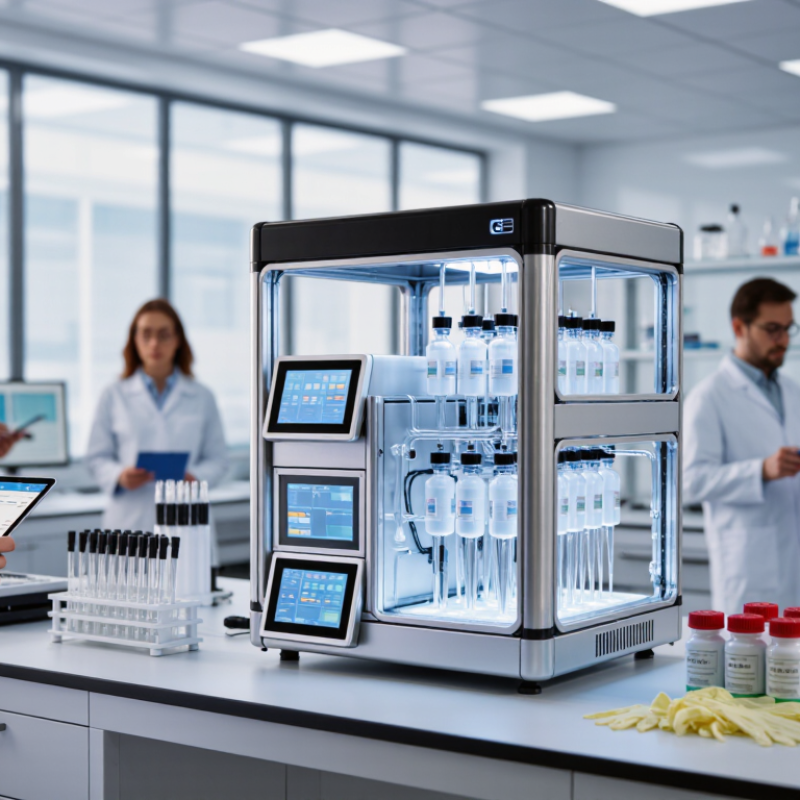
An oligonucleotide synthesizer is an automated instrument that builds short DNA or RNA strands in a programmed sequence. It adds protected nucleotide units through repeated chemical cycles. Each cycle includes coupling, capping, oxidation, and deprotection. The finished strand is then cleaved from its support and purified.
The system resembles a precise liquid-handling workstation. Small reagent lines, heated columns, valves, and software must work together without leaks. Modern platforms can support multiple synthesis columns, helping laboratories produce primers, probes, antisense candidates, and quality-control materials. Grand View Research reports that the global oligonucleotide synthesis market is projected to grow at about 12% annually through 2030. This growth increases demand for reliable automation, not merely higher speed.
When assessing suppliers in China, buyers should examine synthesis scale, channel accuracy, reagent compatibility, software traceability, and local service response. A useful machine should record every batch parameter. It should also allow easy cleaning and maintenance. MarketsandMarkets identifies automation and rising research activity as major market drivers. Yet performance claims need independent verification. A brochure cannot replace yield tests, impurity analysis, and repeated runs. Some laboratories still underestimate contamination risks. That is a costly mistake. Temperature stability and dead-volume control may matter more than a higher advertised throughput. Supplier documentation should include validation records, user training, spare-part access, and realistic installation requirements.
| Evaluation Dimension | Typical Data or Specification | What It Means | Why It Matters When Selecting a Supplier |
|---|---|---|---|
| Core Function | Automated solid-phase synthesis of oligonucleotides | The instrument automatically assembles DNA, RNA, or modified oligonucleotide chains on a solid support. | Confirms that the system is designed for laboratory, diagnostic, therapeutic, or research oligonucleotide production. |
| Standard Chemistry | 3′ to 5′ phosphoramidite chemistry | Most commercial DNA and RNA synthesis uses repeated phosphoramidite coupling cycles. | The supplier should provide compatible reagents, validated synthesis protocols, and appropriate waste-handling guidance. |
| Basic Synthesis Cycle | Detritylation, activation and coupling, capping, and oxidation or sulfurization | These automated steps are repeated for each nucleotide added to the growing chain. | Accurate fluid control and repeatable cycle timing directly affect yield, purity, and batch-to-batch consistency. |
| Supported Product Types | DNA oligonucleotides, RNA oligonucleotides, primers, probes, and modified sequences | Depending on the configuration, systems may support fluorescent labels, spacers, linkers, phosphorothioates, and other modifications. | Check whether the instrument can handle the specific modifications required for diagnostic, research, or therapeutic workflows. |
| Synthesis Scale | From small nanomole-scale synthesis to larger micromole- or millimole-scale production | Available scale depends on the column, solid support, reagent-delivery system, and instrument configuration. | Small scales reduce reagent consumption, while larger scales support increased product quantity and process development. |
| Parallel Processing | Single-column, multi-column, or plate-based operation | Parallel formats allow multiple sequences to be synthesized in one automated run. | Parallel capacity is important for primer libraries, probe panels, screening programs, and high-throughput research. |
| Typical Sequence Length | Routine synthesis commonly covers short to medium sequences, often approximately 10–100 nucleotides | Longer sequences are possible, but cumulative coupling losses generally reduce yield and increase purification requirements. | Suppliers should provide performance data for the sequence lengths and chemistries relevant to the intended application. |
| Reagent Delivery | Computer-controlled delivery of amidites, activators, capping reagents, oxidizers, sulfurizing reagents, and solvents | Precise valves, pumps, tubing, and reaction columns control reagent contact with the solid support. | Low dead volume, chemical compatibility, and stable delivery improve reagent efficiency and synthesis reproducibility. |
| Process Monitoring | Pressure, flow, valve status, reagent levels, alarms, and programmable process records | Monitoring functions help detect blocked lines, leaks, empty reagent bottles, and abnormal fluid delivery. | Real-time alarms and traceable records reduce failed runs and support quality management. |
| Automation Features | Recipe-based operation, sequence import, automatic washing, and programmable synthesis cycles | Users can define sequences and process parameters through instrument software rather than manually operating each step. | Reliable software reduces operator variability and improves productivity in repeated synthesis work. |
| Purification Compatibility | Compatible with downstream desalting, cartridge purification, HPLC, or PAGE workflows | The synthesizer normally performs chain assembly; cleavage, deprotection, and purification may require separate equipment or procedures. | A supplier should clearly define which post-synthesis steps are included and which require additional systems. |
| Cleavage and Deprotection | Usually performed after synthesis using chemistry-specific reagents and controlled conditions | The solid-supported product must be released and protecting groups removed before many downstream applications. | Availability of validated protocols is important for DNA, RNA, modified bases, and sulfur-containing oligonucleotides. |
| Quality Control | Common analytical methods include UV quantification, HPLC, capillary electrophoresis, and mass spectrometry | Analytical testing evaluates concentration, purity, molecular mass, and product identity. | Suppliers should provide recommended QC procedures and interfaces with commonly used analytical workflows. |
| Application Areas | PCR primers, hybridization probes, sequencing, gene regulation research, diagnostics, and drug discovery | Different applications may require different synthesis scales, sequence lengths, labels, and chemical modifications. | Select a system based on the intended product portfolio rather than throughput alone. |
| Chemical Safety | Requires solvent-resistant fluid paths, sealed reagent handling, ventilation, and chemical waste management | Phosphoramidite synthesis uses reactive and volatile chemicals that require appropriate laboratory controls. | Installation guidance, safety documentation, leak detection, and waste compatibility should be evaluated before purchase. |
| Software and Data Records | Sequence files, synthesis recipes, run status, error logs, and batch records | Digital records support repeatability, troubleshooting, and production documentation. | Data export, user permissions, audit trails, and backup options are valuable for regulated or multi-user environments. |
| Supplier Support | Installation, operator training, preventive maintenance, troubleshooting, and spare-parts availability | Instrument performance depends on correct setup, routine cleaning, tubing replacement, and calibration. | Local technical support can reduce downtime and improve the total cost of ownership. |
| Customization Potential | Configurable synthesis scale, column format, reagent channels, parallel capacity, and software recipes | Some systems can be adapted to specific sequence libraries, modifications, or production workflows. | Customization should be assessed together with validation requirements, delivery time, and long-term serviceability. |
Related Posts
-
2026 Top Oligonucleotide Synthesizer Models and Their Applications?
-

Top HPLC Chromatography Techniques for Effective Separation Methods?
-
2026 How to Choose the Best Peptide Synthesizer Machine?
-
2026 Top Lyophilization Equipment Manufacturers?
-
2026 How to Choose the Best Lyophilization Equipment Manufacturers?
-

10 Essential Tips for Optimizing Biopharmaceutical Manufacturing Processes?