
China Top Illuminated Tact Switch Manufacturers
An Illuminated Tact Switch looks simple: a compact cap, a crisp click, and a visible glow. Its performance depends on less visible details, including contact design, LED placement, operating force, travel, and light leakage. In a control panel or handheld device, these details affect both usability and the product’s perceived quality. Small component, real consequences.
Demand for compact electronic devices provides useful market context. IDC reported that worldwide smartphone shipments reached 1.24 billion units in 2024, increasing 6.4% from 2023, according to its Worldwide Quarterly Mobile Phone Tracker, published in January 2025. This figure does not measure tact switch sales. It does, however, show the scale of products where compact controls and clear visual feedback can matter. That distinction is worth keeping.
This overview examines China-based manufacturers through practical purchasing and engineering considerations: product range, customization, sample consistency, documented specifications, and communication during development. Buyers should check datasheets against physical samples, especially for actuation force, dimensions, illumination uniformity, and expected operating life. A bright prototype is not enough. Supplier claims should be verified against test conditions and application needs. Public market reports rarely isolate illuminated tactile switches as a separate category, so precise market-size claims deserve caution. The aim here is not to declare one supplier universally best, but to help readers compare options with better questions and clearer evidence.
What Illuminated Tactile Switches Are and How They Work
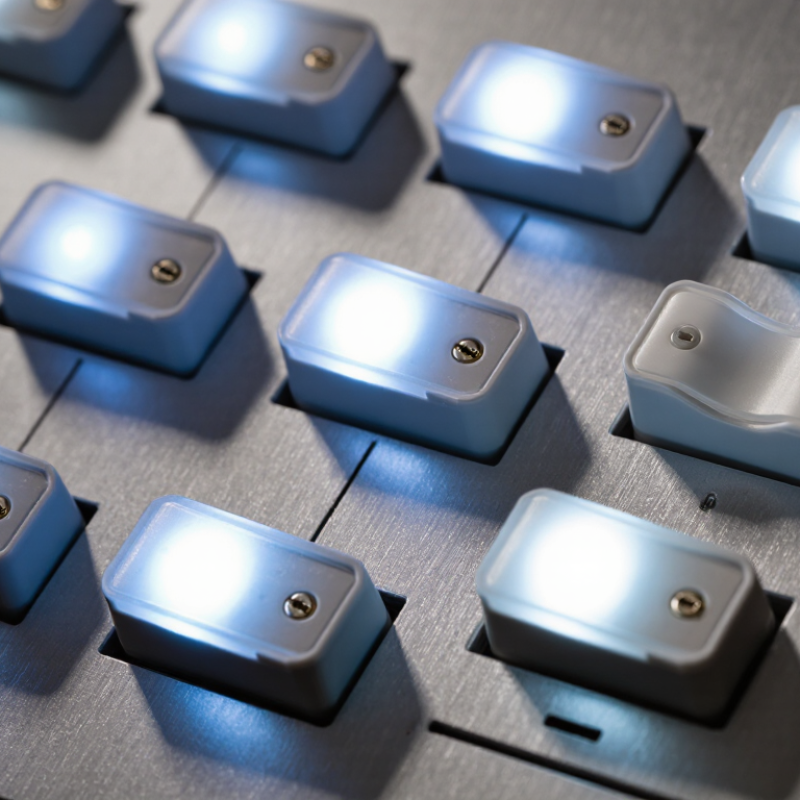
An illuminated tactile switch joins a momentary switch mechanism with a small light source, commonly an LED. Pressing the cap pushes a metal dome or spring until contacts meet, completing the circuit. Release it, and the dome returns, opening the circuit with a noticeable click. The LED usually has its own electrical path, so it can stay lit independently of the switch state. A light pipe or translucent cap spreads its glow across the button face.
The detail matters in real equipment. On a dim control panel, a softly lit cap can help a person locate a button; a bright, exposed LED may cause glare instead. Designers should check operating voltage, current, travel, and mounting space, then test the switch under actual ambient light. The light alone does not confirm that a command worked. That distinction is easy to miss.
Grand View Research estimated the global LED lighting market at USD 75.4 billion in 2023 and projected a 10.8% compound annual growth rate from 2024 to 2030. This is broad lighting-market context, not a measurement of tactile-switch sales. Still, it reflects the wider use of LED illumination in interfaces, where compact illuminated controls can improve visibility without adding a separate indicator. One limitation remains: a tactile click can feel reassuring, but it does not prove the electrical contact is reliable over time.
China Top Illuminated Tact Switch Manufacturers - What Illuminated Tactile Switches Are and How They Work
| Data Dimension | What It Means | How It Works or Is Specified | Selection Consideration |
|---|---|---|---|
| Switch definition | A momentary tactile switch with an integrated light source, commonly an LED. | Pressing the actuator changes the electrical contact state; the LED is powered through its own electrical path. | Confirm whether the design needs momentary or latching behavior. Most tact switches are momentary. |
| Main construction | Typically includes an actuator, spring or dome mechanism, contacts, housing, terminals, and LED. | The mechanical parts create tactile feedback, while the LED and switch contacts perform separate functions within the assembly. | Review terminal layout, actuator shape, mounting method, and available space on the PCB. |
| Operating sequence | The press, electrical actuation, and return movement of the switch. | A press moves the actuator and changes the contact state. Releasing it allows the mechanism to return to its initial position. | Check operating force, travel, and tactile feel against the user's needs and the product's enclosure design. |
| Contact configuration | The arrangement of the switching contacts, commonly specified as SPST or SPDT. | SPST provides one switched circuit; SPDT provides one common connection that switches between two contacts. Actual options depend on the design. | Match the contact form to the circuit schematic and verify normally open or normally closed behavior. |
| LED color and type | The light source's color and electrical configuration. | Single-color and multi-color options are available across different product designs. A multi-color LED may contain separate LED elements or a shared-anode/shared-cathode arrangement. | Check the datasheet for LED polarity, forward voltage, recommended current, and pin assignment. |
| LED drive circuit | The circuit that supplies current to the integrated LED. | An LED requires current limiting, commonly provided by a series resistor or a suitable driver. The LED is not necessarily powered by the switch contacts. | Design for the LED's specified forward voltage and operating current; do not assume the LED and switch share a circuit. |
| Illumination method | How light exits the component and appears at the control surface. | Light may pass through a translucent actuator, a lens, or a light guide, depending on the switch construction. | Evaluate the installed switch with the actual panel, graphics, and ambient lighting to check brightness and uniformity. |
| Operating force and travel | The force needed to actuate the switch and the distance the actuator moves. | Both values are model-specific and should be taken from the manufacturer's datasheet rather than inferred from appearance. | Compare specified values and tolerance ranges; test samples where tactile feel is important. |
| Electrical ratings | Permitted voltage and current for the switch contacts and LED. | Contact ratings and LED ratings are separate specifications. Ratings vary by model and are stated in the product datasheet. | Check load type, switching conditions, LED drive requirements, and any derating guidance. |
| Mounting and termination | The way the switch is attached and electrically connected. | Common formats include PCB through-hole and surface-mount terminals; available formats depend on the series. | Check footprint, pin spacing, soldering process compatibility, and actuator alignment with the panel. |
| Environmental protection | Resistance to dust, water, vibration, and temperature conditions. | Protection ratings and operating limits are product-specific. A switch's rating should be confirmed from its datasheet and test conditions. | Choose a suitable rating for the finished assembly; the PCB-mounted component alone may not seal the panel opening. |
| Manufacturer evaluation | How to assess suppliers of illuminated tact switches without relying on brand claims alone. | Compare datasheet completeness, sample consistency, production controls, traceability, customization options, and test documentation. | Request current specifications, drawings, samples, and relevant compliance documents for the exact part number. |
Note: Electrical, mechanical, and environmental specifications vary by model. Verify all limits and ratings in the datasheet for the selected switch.