A Garden Shed can look perfect in a photograph and still disappoint once it reaches your yard. Door clearance, floor strength, ventilation, and weather resistance matter more than decorative trim. For global buyers, shipping dimensions, assembly instructions, and access to replacement parts deserve equal attention. Small details count.
Architect Louis Sullivan’s famous principle, “form ever follows function,” offers a useful lens for comparing sheds. It is not a shed-buying rule, but it reminds buyers to match design with everyday use. Will the shed store a mower, protect bicycles, or hold garden tools through a wet winter? Measure bulky items, check the proposed foundation, and compare material options against your local climate. A timber model may need regular care; metal or resin models bring different trade-offs. Check the supplier’s specifications rather than relying on appearance alone.
This guide explores ten practical checks, from materials and roof design to warranties, delivery, and assembly support. Ask sellers for clear dimensions and written product details. Confirm whether the quoted price includes delivery and the parts needed for assembly. Then compare answers, not just photos. There is no perfect shed for every buyer. I would still want to inspect the details twice—especially when ordering across borders.
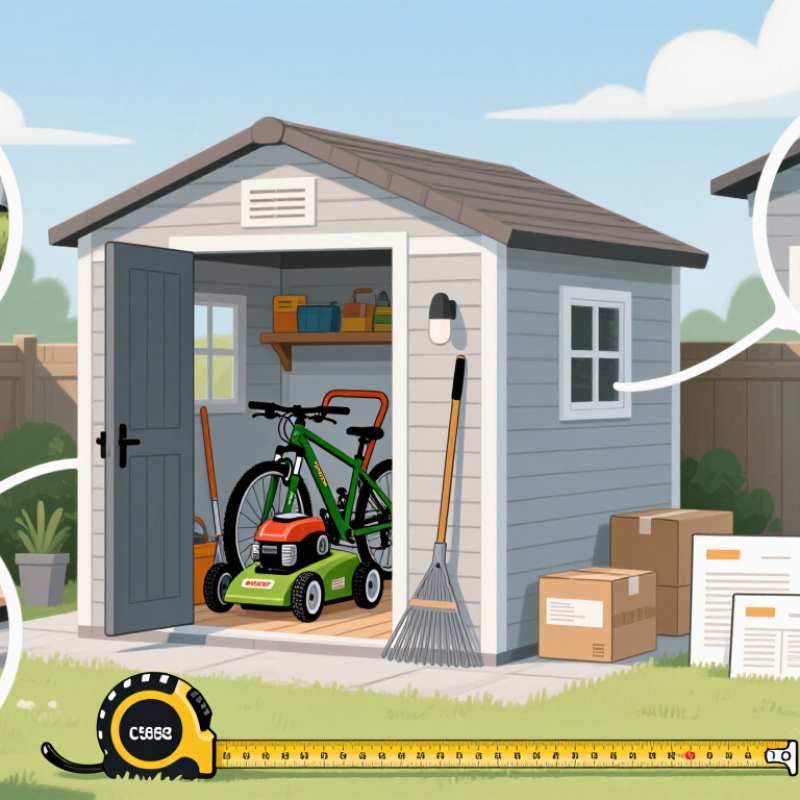
Define capacity before comparing shed dimensions. List what must fit: a mower, two bicycles, shelving, and seasonal boxes. Add their working space, not just their parked footprint. A 6-by-8-foot floor may hold the items on paper but feel cramped when you turn or reach for a tool. Measure twice. Leave breathing room.
Tips: Sketch the floor plan on paper, then mark it on the ground with string or chalk. Place bulky items first. Check that the door opens fully and that you can walk past stored equipment. Planning sketches often look cleaner than real use, so allow a little extra space.
Headroom and door width matter as much as floor area. Measure tall equipment, including handles, and compare it with the interior height beneath roof beams. A low doorway can make a spacious shed awkward to use. Measure the widest item that must pass through, then allow clearance for hands and turning. Check the route from the delivery point too; a wide shed may be difficult to position in a narrow yard. Small gaps on a drawing can become annoying in daily use. I would rather leave one shelf unfilled than discover the mower blocks the entrance.
Before choosing a garden shed, assess the exact site—not just the weather in the nearest city. A fence, hill, or open field can change wind exposure. ASCE 7-22 provides site-specific wind and snow hazard values; its maps distinguish risk categories and local conditions. In Europe, EN 1991-1-4 sets out wind actions, while EN 1991-1-3 addresses snow loads. Under the Eurocode approach, basic wind speed and characteristic snow loads use a 50-year reference period. Check the applicable national annex, too.
Look for numbers, not vague claims like “wind-resistant.” Record the site elevation, nearby terrain, roof pitch, and whether snow drifts beside walls or trees. Then compare those conditions with the shed’s stated design loads. A shed tucked behind a house may face less wind, but a roof beside a taller building can collect drifting snow. Small details matter. One common mistake is treating a regional snow map as the load on every roof; exposure, roof shape, and drifting can change the result. If the supplier cannot provide design-load figures, ask a qualified local professional to review the site before purchase. Standards guide the assessment, but they do not replace site-specific judgment.
Check local wind and snow design requirements before choosing a shed. The chart shows equivalent ground snow-load values using the exact conversion 1 psf = 0.04788 kPa; these are unit conversions, not recommended design loads.
Use the site-specific mapped values and required factors under ASCE 7 or the applicable EN 1991 provisions and National Annex. Snow drift and unbalanced loads, wind speed, terrain exposure, topography, and building enclosure can all affect design. Consult local requirements or a qualified professional.
ASTM A653/A653M defines G90 as a minimum zinc coating mass of 0.90 oz/ft², or about 275 g/m², across both sheet faces. That is coating weight, not a thickness rating. If distributed evenly, it represents roughly 19 micrometres per face, though actual coverage can vary. Ask suppliers for the coating designation and mill test documentation, not just a product-page claim. On a shed panel, inspect cut edges, fastener holes, and scratched corners; these small areas often reveal handling quality.
Location changes the corrosion picture. ISO 9223 puts zinc’s first-year corrosion rate in category C3 at 0.7–2.1 micrometres per year. Salt spray, damp air, and industrial pollution can raise exposure, so this range does not promise a shed’s service life. A useful comparison includes G90 coating, steel thickness, drainage design, and the intended site. One detail is easy to miss: a higher coating mass cannot fix water trapped beneath a poorly fitted trim. I would still want clear documentation; labels alone leave room for doubt.
Before ordering a garden shed, check the ground where it will stand. Walk the site after rain and look for puddles, soft patches, or water flowing toward the building. Water tells you a lot. A slight slope can help drainage, but the shed still needs a level, stable base. Avoid low spots beneath roof runoff or near downpipes. A lawn may look firm while hiding loose fill or shallow roots. It is easy to miss.
Match the foundation to the soil and the shed’s expected load. A small timber shed on firm, well-drained ground may suit a compacted gravel base. Larger sheds, heavy tools, or shelving full of supplies may need a stronger slab or another engineered foundation. Think about loads from stored equipment, as well as local snow and wind conditions. The floor should not flex underfoot. Check how the shed will be anchored, too; a sound base alone may not prevent movement in strong gusts. Soil, frost depth, and drainage vary by region, so ask a qualified local builder when conditions are uncertain. A few extra measurements now can prevent a crooked door later.
Before ordering a garden shed, check whether its size triggers a permit. The 2021 International Residential Code (IRC), Section R105.2, exempts certain one-story detached accessory structures from building permits at 200 square feet or less (18.58 m²). The exemption covers Tool Sheds, storage sheds, playhouses, and similar uses. This ICC model-code threshold is a useful reference, not a global guarantee. Local adoption, zoning setbacks, fire rules, and utility connections can change the answer.
Tip: Contact the local building office before paying a deposit. Send the shed’s dimensions, intended use, and a simple site sketch. Ask about permits, setbacks, and any limits on height or placement. Keep the reply with your purchase records. Small detail. Big difference.
Measure the floor area, not the roof overhang. An 8-by-25-foot floor reaches 200 square feet, so a small design change may cross the threshold. Local officials may also interpret measurements or exemptions differently. For international buyers, confirm which building code applies at the delivery site; the IRC is a U.S. model code, not a worldwide standard. I would not assume “permit-exempt” means “free to place anywhere.”